
November 11, 2026
A Simple Skincare Routine for Acne-Prone Skin: What to Keep and What to Skip
A Simple Skincare Routine for Acne-Prone Skin: What to Keep and What to Skip
A cleanser for oil, a serum for marks, an exfoliant for bumps—and still another breakout. If your routine is growing while your skin feels less comfortable, start by making each step earn its place. A simple skincare routine for acne-prone skin should support your skin and any prescribed treatment, not leave you guessing which of six new products caused the irritation.
You can begin with gentle cleansing, appropriate moisturising and sun protection. If breakouts persist or are leaving scars, Dr. Chio Aesthetic and Laser Centre, Bedok can help you take the next step through a skin assessment. The useful question is what your skin needs now, before choosing a facial or a scar procedure.
Morning: keep the basics clear
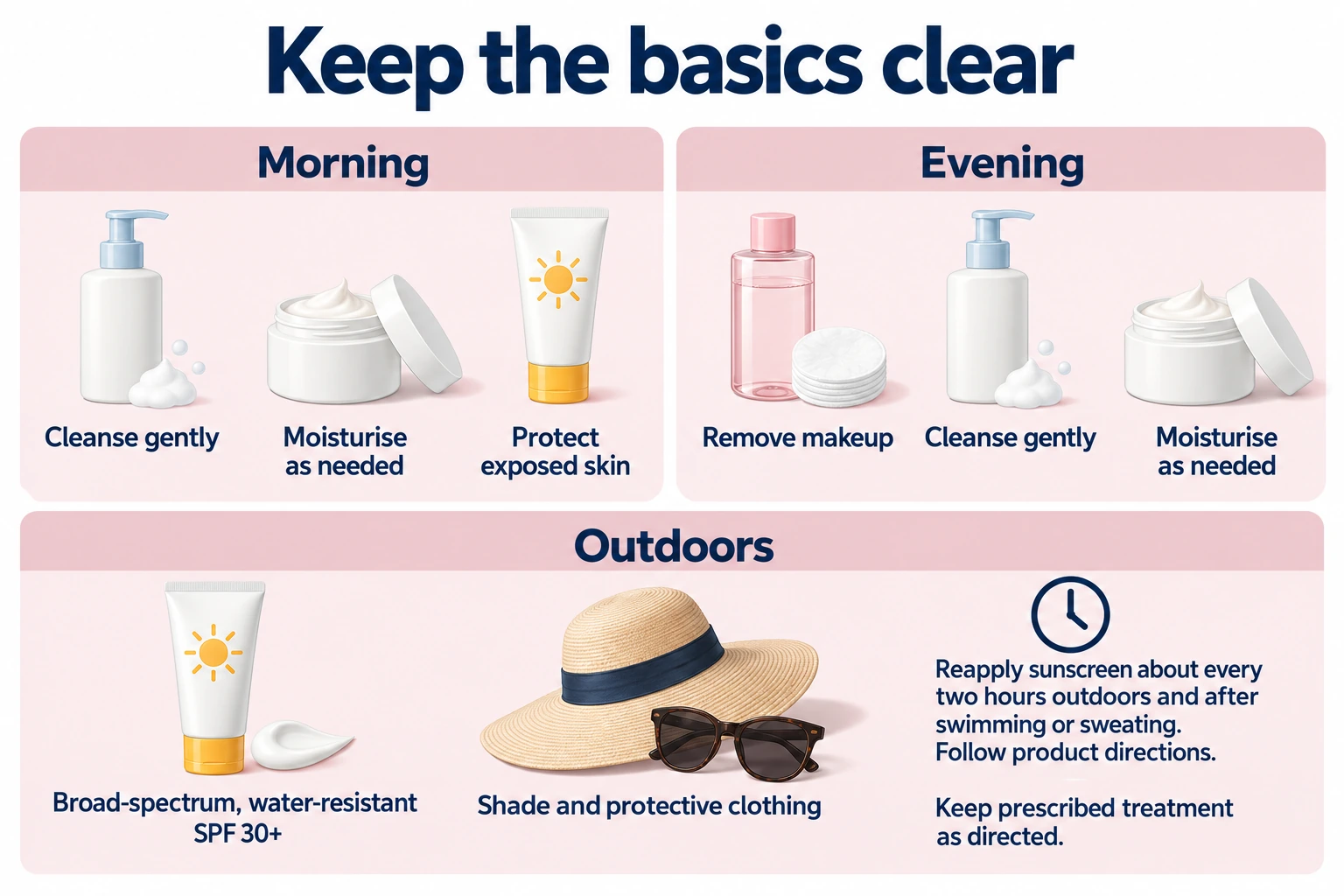
Cleanse gently. Use a mild, non-abrasive cleanser and your fingertips rather than a scrub or cleansing brush. Rinse without rubbing the skin hard. The American Academy of Dermatology’s acne-care guidance recommends washing up to twice a day and after sweating—not repeatedly whenever your face feels oily.
Moisturise when your skin feels dry. Oily skin can still feel dry or irritated. Look for an acne-friendly moisturiser described as oil-free, non-comedogenic or unlikely to clog pores. Apply it after washing, while the skin is still slightly damp. The AAD explains how moisturiser can support acne-prone skin, including skin affected by drying acne treatments.
Protect your skin outdoors. Choose broad-spectrum, water-resistant sunscreen with SPF 30 or higher and a non-comedogenic label. Use it on exposed skin alongside shade and protective clothing. Reapply outdoors about every two hours and after swimming or sweating, following the product’s directions. The AAD’s practical skin-care guide includes sunscreen as a basic step, not an optional extra.
If you already use prescribed acne treatment, follow its instructions about timing and product order. This outline does not replace that plan. Ask your treating clinician if you are unsure how the basics fit around it.
Evening: remove the day without stripping your skin
Take off makeup before bed, then cleanse gently. You do not need your skin to feel tight or “squeaky clean” to know it has been washed. The AAD advises against sleeping in makeup and harsh scrubbing.
Use your prescribed treatment as directed and moisturise as appropriate. Keep the sequence manageable enough to repeat on a tired evening. A routine you understand and can maintain is more useful than an elaborate one you frequently abandon.
Separate two questions: “What do I need to remove?” and “What treatment am I using?” Removing makeup is a cleansing task; adding another acid or scrub is a treatment decision. Treating them as the same thing can lead to unnecessary layering.
Decide what deserves a place on the shelf
Before adding a product, write down the job you want it to do. Is it intended to cleanse, moisturise, protect, manage breakouts or address a different concern? If you cannot explain its purpose, pause before buying it.
Make optional changes one at a time rather than replacing your entire routine together. This is a practical way to keep track of your response—not a substitute for following a prescribed combination treatment. Keep a simple note with:
- Product name and the date you introduced it.
- How often you use it and where you apply it.
- Dryness, stinging, redness or other changes you notice.
- Any changes to prescribed treatment or other skincare.
A label saying non-comedogenic is useful, but it is not a guarantee that a product will suit every person. If something causes a troublesome reaction, seek advice rather than assuming discomfort proves it is working. Do not keep layering products over irritated skin.
Avoid the habits that make assessment harder
Picking or squeezing can increase the risk of marks and scarring. Scrubbing and frequently switching acne treatments can also irritate the skin. Those points are part of the AAD’s acne-management recommendations.
Give an agreed treatment plan time to be reviewed instead of judging it after every new spot. At the same time, do not ignore a significant reaction or keep using something harmful because you have been told to “push through.” Ask what improvement to look for, when to review progress and which symptoms should prompt earlier contact.
Try to keep your observations consistent. Rather than checking under changing bathroom lights throughout the day, note the areas affected and any symptoms. If you take personal progress photographs, use similar lighting and avoid filters; bring them to your appointment if they help explain the pattern.
When a routine needs help from a doctor
Arrange an assessment if acne remains troublesome, becomes deep or painful, or is leaving scars. You can also seek help because breakouts are affecting your confidence or daily life; you do not need to wait for the problem to become severe. The AAD describes how acne treatment is matched to the type and severity of acne.
At Dr. Chio Aesthetic and Laser Centre, Bedok, bring your product list, current medicines and the questions you want answered. Explain whether the priority is ongoing breakouts, marks left behind, uneven texture or a mixture. That helps focus the assessment on the next useful step rather than adding another product without a clear reason.
Put active acne and scar treatment in the right order
Dr. Chio Aesthetic and Laser Centre, Bedok offers skin treatments including HydraFacial MD, Secret RF and eCO2 Plus. They have different roles. A facial can be discussed for suitable surface-care needs; it should not replace assessment of persistent acne. Secret RF and fractional CO2 resurfacing belong in an appropriate scar or texture discussion, not a promise to cure active breakouts.
A routine also cannot be expected to fill established dents simply by adding more moisturiser. If breakouts and scars coexist, ask which concern should be addressed first and what can reasonably wait. That is a more useful plan than choosing the most prominent device online.
Get a clearer plan for your skin in Bedok
If your routine is becoming complicated but your acne is not improving, WhatsApp the team at Dr. Chio Aesthetic and Laser Centre, Bedok to enquire about a skin assessment. Mention whether you have ongoing breakouts, irritation or new scars, and ask what to bring. You can also send an appointment enquiry.
The clinic is at 158 Bedok South Ave 3 #01-581, Singapore; telephone +65 6442 8375. Start with understanding your skin, then decide which care or treatment is worth adding.
Frequently asked questions
Should I skip moisturiser because my skin is oily?
Not automatically. If your skin feels dry, an acne-friendly moisturiser can support comfort. Look for oil-free or non-comedogenic options and discuss persistent irritation with your clinician.
Do I need an exfoliating toner every day?
It is not a required basic step. Harsh or unnecessary exfoliation can irritate acne-prone skin, especially when combined with acne treatment. Check how an optional product fits your existing plan before adding it.
Can better skincare remove my acne scars?
Good skincare can support skin care during acne treatment, but it should not be expected to erase established depressions or raised scars. Ask for assessment of ongoing acne and the marks or texture changes it has left behind.