
November 5, 2026
Persistent Facial Redness: How to Keep a Trigger Diary and Prepare for an Assessment
Persistent Facial Redness: How to Keep a Trigger Diary and Prepare for an Assessment
Persistent facial redness can leave you unsure what to change: your cleanser, your meals, your exercise routine or the treatment you have been considering. Start by recording what happens rather than changing everything at once. A short trigger diary can help you describe the pattern and have a more focused conversation with a doctor.
At Dr. Chio Aesthetic and Laser Centre, Bedok, you can enquire about assessment for recurring redness and discuss whether the clinic’s rosacea or laser-treatment options are relevant. The first question is what is causing your symptoms, not which device to book.
Redness is a symptom, not a diagnosis
Rosacea is one possible explanation for persistent redness, flushing or acne-like bumps, but other conditions can look similar. These include acne and different forms of dermatitis. An examination helps distinguish conditions that may need different care. The NHS rosacea overview explains this overlap.
Describe how your skin feels as well as how it looks. Warmth, stinging, dryness, visible vessels and the length of a flush can all be useful details. On darker skin, colour changes may look brown or violet rather than bright red, and warmth may be easier to notice than flushing. The American Academy of Dermatology describes these varied signs.
A diary cannot diagnose rosacea or prove an allergy. Its purpose is to make an intermittent problem easier to explain, especially if your skin looks calmer on the day of your appointment.
How to start a useful trigger diary
Choose a notebook or a simple note on your phone. Keep entries short enough that you will actually complete them. A two-week record is a reasonable starting point if symptoms are mild and you are otherwise well; do not postpone needed care to finish it. The AAD recommends tracking possible rosacea triggers and symptoms.
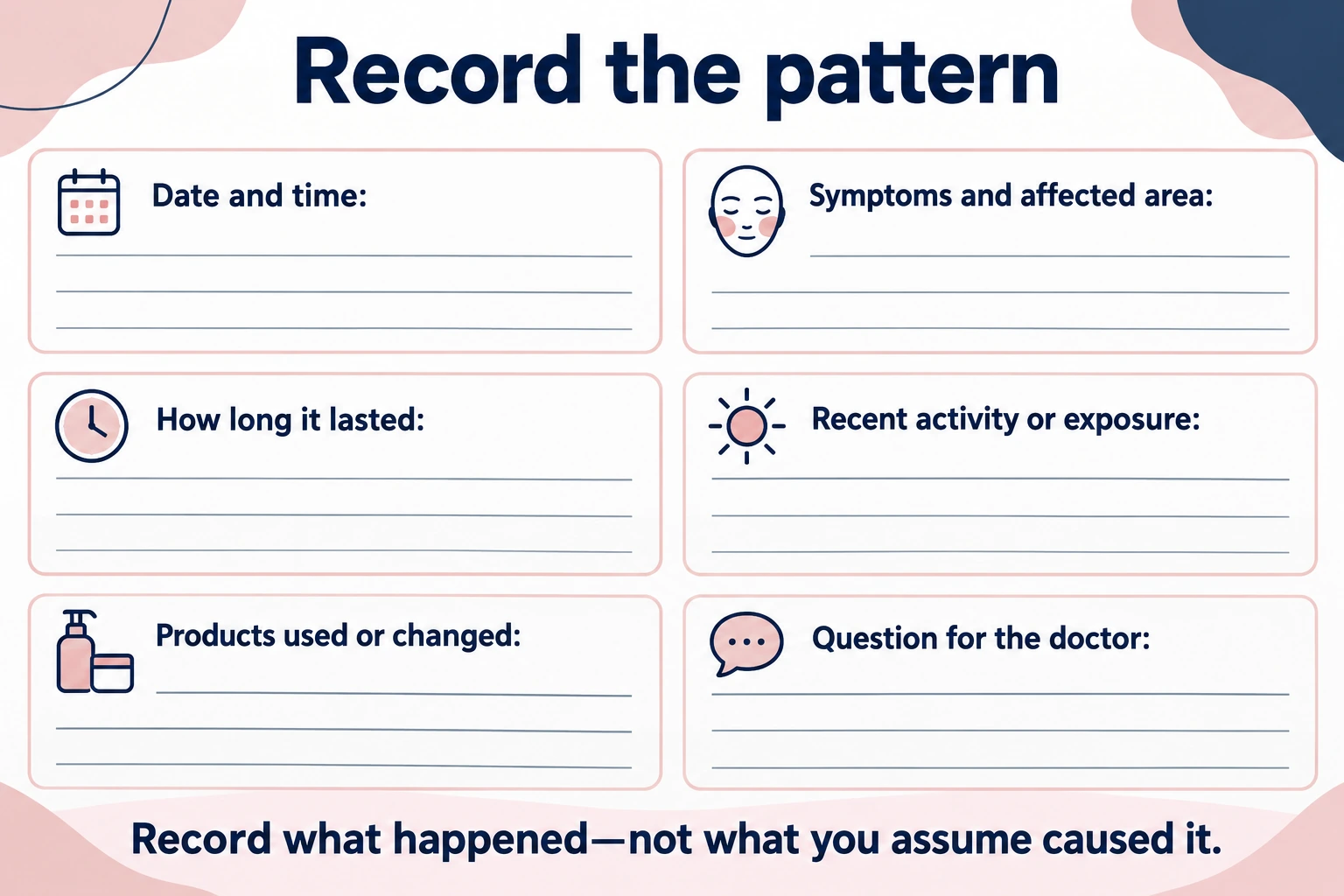
Use these headings:
- When and where: date, approximate time and affected area.
- What happened: flushing, warmth, bumps, burning or another symptom, plus roughly how long it lasted.
- What preceded it: sun or heat exposure, exercise, food or drink, stress, and products used.
- What changed: a new product, a different routine or a recent treatment.
- What you want to ask: one question raised by that day’s experience.
Do not aim to record every minute. A brief entry after an episode and a quick daily review are easier to sustain than a complicated spreadsheet.
Record observations, not conclusions
Use a brief template: date and time; symptoms; recent activity or exposure; products used; duration; questions for the doctor.
Notice the difference between “after lunch” and “caused by lunch”. Several things happen together during a normal day. One episode does not justify cutting out a whole food group or assuming that a product allergy has been established.
You can use a consistent personal scale such as mild, moderate or severe to compare your own entries. This is a memory aid, not a medical scoring system. If you take photographs, keep the lighting similar and avoid filters. Keep them private and bring useful examples to the consultation rather than posting them for public diagnosis.
Look for patterns without making your life smaller
Common rosacea triggers include sunlight, heat, stress, alcohol, spicy foods, exercise and some skincare products. People differ: a list of possible triggers is not a list of things everyone must avoid.
After recording several episodes, highlight repeated circumstances and discuss them with your doctor. Ask which changes are worth trying and how to judge whether they help. You do not need to abandon exercise or remove many foods because they appear on a generic list.
Make your question specific: “These three episodes happened after outdoor activity; how can I manage that?” is more useful than “Is everything bad for my skin?” Keep prescribed medicines unchanged unless the treating clinician advises otherwise.
Keep daily skincare gentle while you investigate
For rosacea-prone skin, the AAD’s skincare advice favours gentle cleansing, moisturising and sun protection. Wash using your fingertips rather than scrubbing tools, rinse gently and pat dry. Choose fragrance-free products and avoid adding exfoliating treatments to an already irritated routine.
Use a broad-spectrum, water-resistant sunscreen with SPF 30 or higher, and add shade and protective clothing outdoors. If products repeatedly sting, ask for guidance rather than cycling through more treatments. Tell the doctor what you have tried, including anything marketed for sensitive skin.
Bring photographs of product labels if that is easier than remembering names. The aim is to understand your current routine and make it more comfortable, not to arrive with an expensive replacement collection.
Where ADVATx and other clinic options may fit
At Dr. Chio Aesthetic and Laser Centre, Bedok, you can discuss rosacea care and ADVATx Yellow Laser for appropriate redness concerns. If visible vessels or persistent redness are bothering you, ask whether these options address the findings from your assessment.
Laser and light treatments may have a role in managing visible vessels or some redness, but they do not cover every feature of rosacea or every cause of a red face. A broader plan may include skincare, trigger management and medical treatment. The AAD’s laser and light overview explains that procedures are generally part of a plan rather than the whole plan.
Ask what a proposed treatment is intended to improve: visible vessels, background redness or something else. Discuss possible discomfort, temporary redness, other side effects and aftercare. Your skin history, current medicines and past reactions matter to that discussion. Ask about recovery, reviews and total costs before deciding; a device name alone cannot answer those questions.
When to seek help sooner
Arrange medical assessment if redness keeps returning, persists or is becoming uncomfortable. Mention eye symptoms, too. Eye pain, blurred vision, light sensitivity or a red or gritty eye needs urgent medical assessment rather than a routine aesthetic appointment. Do not wait for your diary to be complete. This warning is also highlighted in the NHS rosacea guidance.
Frequently asked questions
Does a trigger diary tell me whether I have rosacea?
No. It provides a record of symptoms and circumstances. The doctor uses your history and examination to assess possible causes and decide whether further evaluation is needed.
Must I stop coffee, spicy food and exercise?
Not automatically. Triggers vary, and several exposures can occur together. Record your experience and discuss practical, targeted changes rather than imposing blanket restrictions on yourself.
Can ADVATx cure rosacea?
Do not approach it as a cure. Dr. Chio Aesthetic and Laser Centre, Bedok offers ADVATx for suitable redness concerns. Ask what it may improve in your case and what ongoing care would still be needed.
Get a clearer plan for recurring redness
Contact the team at Dr. Chio Aesthetic and Laser Centre, Bedok or WhatsApp +65 9651 1224 to ask about a skin assessment, consultation fees and availability. The clinic is at 158 Bedok South Ave 3 #01-581, Singapore. Bring your diary and product list so you can move from guessing at triggers to discussing a plan for your skin.